
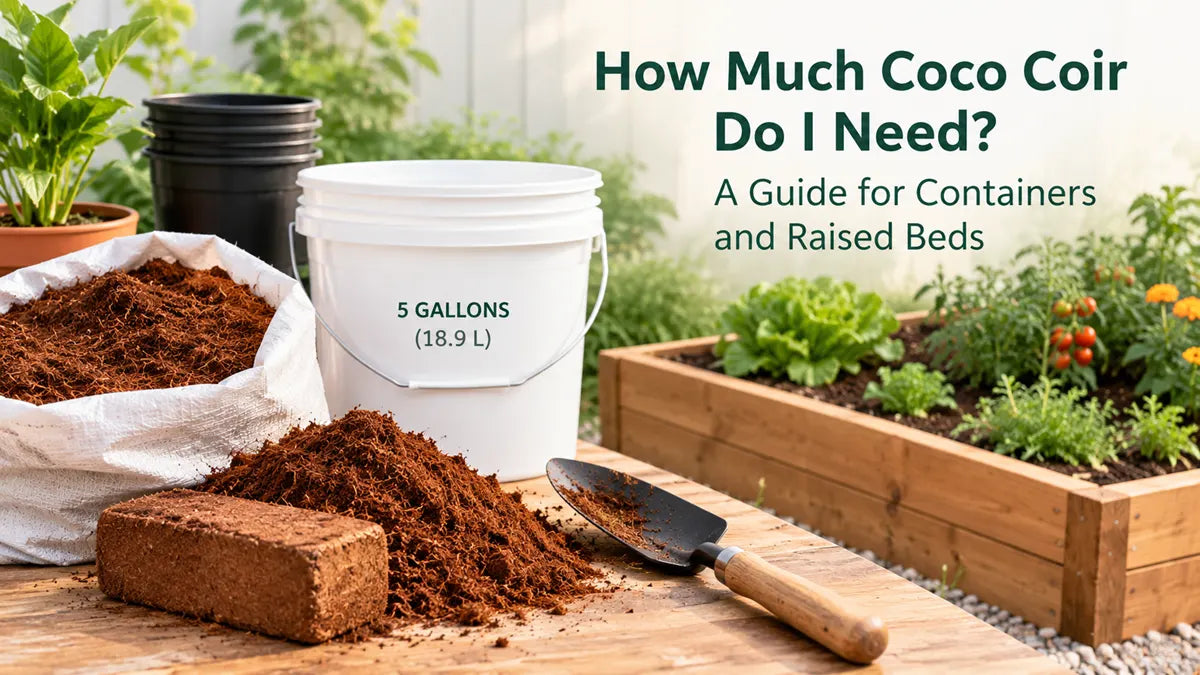
How Much Coco Coir Do I Need? A Guide for Containers and Raised Beds
Key Takeaways
- Calculate the amount of coco coir you need using your container’s volume and the amount of growing medium you plan to use.
- A 5-gallon container holds approximately 18.9 liters, but that does not mean you need 18.9 liters of coir.
- Raised-bed calculations are easier when you measure the bed’s length, width, and depth before purchasing.
- The right coco coir-to-soil ratio depends on your plants, existing soil, growing method, and the properties of the coir product.
- Check the selected product’s listed expansion yield and preparation instructions before deciding how many bricks, blocks, or other formats to buy.
Introduction
Buying too little coco coir can interrupt a planting project. Buying too much can leave you with unused growing medium and unnecessary storage needs. The easiest way to avoid both problems is to calculate the volume you need before choosing a product.
At True Coirs, we offer coco coir in different formats, so the amount you need depends on your project and the specific product you select. A compressed block, a small disc, and a loose growing medium should not automatically be treated as having the same yield or preparation requirements.
In this guide, we’ll explain how to calculate coco coir for containers and raised beds, estimate the amount needed for a soil mix, and use a product’s stated expansion yield to plan your purchase.
1. Understand Container Volume Before Buying Coco Coir
The first step is to determine how much growing medium your container holds. Container volume tells you the maximum space available for the entire growing mix—not necessarily the amount of coco coir you need.
Gallons to liters
Many containers are labeled in gallons, while coco coir products may list expanded volume in liters.
For U.S. liquid gallons, the conversion is:
1 U.S. gallon = approximately 3.785 liters.
This conversion is listed in the National Institute of Standards and Technology’s U.S. conversion factors.
Here are some useful approximate conversions:
|
Container volume |
Approximate volume in liters |
|
1 gallon |
3.8 L |
|
3 gallons |
11.4 L |
|
5 gallons |
18.9 L |
|
7 gallons |
26.5 L |
|
10 gallons |
37.9 L |
|
15 gallons |
56.8 L |
These are capacity conversions, not recommendations to fill every container with pure coco coir. If you are making a blend, only part of the container’s volume will be coir.
How much coco coir do I need for a 5-gallon bucket?
A 5-gallon bucket holds approximately 18.9 liters. Your coir requirement depends on how you intend to use it.
- Pure coco coir: You would need enough prepared coir to fill the volume you intend to use, allowing for the actual shape and fill level of the container.
- A coir-and-soil blend: You need only the portion of the total mix assigned to coco coir.
- A partial fill: Calculate the volume you plan to fill rather than using the bucket’s full rated capacity.
For example, if you decide to use a hypothetical mix containing 30% coco coir by volume in a 5-gallon container:
18.9 L × 0.30 = approximately 5.7 L of expanded coir
The remaining 70% of the mix would be other ingredients. This 30% figure is a calculation example—not a universal recommendation for all plants, soils, or growing systems.
2. Check How Much Your Selected Coco Coir Product Expands
Compressed coco coir products are designed to occupy less space before preparation. Their expanded yield can vary by product, format, moisture content, compression, and processing.
Do not estimate the number of bricks or blocks from weight alone. Check the listed expanded yield for the exact product you plan to purchase.
For example, the True Coirs Premium Coconut Coir Pith 5 kg block lists an approximate expanded volume of 70–75 liters. That figure applies to this specific product listing and should not be assumed to describe every True Coirs product.
To estimate the number of units needed:
Units required = total expanded coir volume needed ÷ stated expanded yield per unit
Round up to the next whole unit if you need to meet or exceed your calculated volume.
Example: Estimating the number of blocks
Suppose your project requires 120 liters of prepared coir, and the product you select lists an expanded yield of 70 liters per block.
120 L ÷ 70 L per block = 1.71 blocks
You would need 2 blocks to meet the estimated requirement.
This is a planning estimate, not a guarantee of the final volume. Follow the product’s current preparation instructions, and allow for differences in handling, settling, and how tightly the medium is packed.
Ready to compare formats? Browse the True Coirs product collection and check the specifications for the product that best fits your project.
3. Quick-Reference Guide to Coco Coir for Containers
Use this table to estimate the amount of coir for a container when you already know the percentage of the mix you want to allocate to it.
|
Container size |
Total volume |
Coir at 25% of mix |
Coir at 50% of mix |
|
1 gallon |
3.8 L |
0.9 L |
1.9 L |
|
3 gallons |
11.4 L |
2.8 L |
5.7 L |
|
5 gallons |
18.9 L |
4.7 L |
9.5 L |
|
7 gallons |
26.5 L |
6.6 L |
13.3 L |
|
10 gallons |
37.9 L |
9.5 L |
18.9 L |
|
15 gallons |
56.8 L |
14.2 L |
28.4 L |
All values are approximate calculations. The 25% and 50% columns are examples of chosen mix proportions, not universal growing recommendations.
To use the table, select the container size and the proportion of the total mix you plan to make up of coco coir. Then compare that volume with the stated expanded yield of your selected product.
Keep in mind that container labels may describe nominal capacity. Actual usable volume can differ because of the container’s shape, drainage space, and the level to which you fill it.
4. How Much Coco Coir Do I Need for a Raised Bed?
Raised beds can require much more growing medium than individual pots, so measure the bed before purchasing.
Step 1: Calculate the bed’s volume
Measure the bed’s internal length and width, then measure the depth you intend to fill.
For measurements in feet:
Volume in cubic feet = length × width × fill depth
For measurements in inches:
Volume in cubic feet = length × width × depth ÷ 1,728
The divisor 1,728 converts cubic inches to cubic feet.
For example, a raised bed measuring 4 feet long, 4 feet wide, and 1 foot deep has a volume of:
4 × 4 × 1 = 16 cubic feet
That is the estimated volume of the entire growing medium, not the volume of coco coir alone.
Step 2: Decide how much of the mix will be coco coir
If you have chosen a coir proportion for your growing plan, multiply the bed’s total volume by that proportion.
For the 16-cubic-foot bed above, a hypothetical mix containing 20% coco coir would require:
16 cu ft × 0.20 = 3.2 cubic feet of coir
This example illustrates the calculation only. It is not a recommendation to use 20% coco coir in every raised bed.
The appropriate blend depends on your existing soil, drainage, climate, plants, irrigation, and the characteristics of the other ingredients. For guidance on building and managing raised-bed soil, consult University of Minnesota Extension’s raised-bed gardening guidance and Rutgers Cooperative Extension’s soil guidance for raised beds.
Step 3: Convert the coir requirement into product units
Once you know the required volume, use the expanded-yield information on the selected product listing.
Make sure the units match before dividing. If your calculation is in cubic feet and the product yield is in liters, convert one measurement first.
1 cubic foot is approximately 28.3 liters.
For instance, 3.2 cubic feet is approximately 90.6 liters. If a selected product lists a 70-liter yield per unit, the calculation would be 90.6 ÷ 70 = 1.29, meaning you would plan for 2 units. This remains an estimate based on the stated yield of the hypothetical product.
5. How Much Coco Coir Should I Mix With Soil?
There is no single coco coir-to-soil ratio that works for every garden. The right proportion depends on what you are trying to change about the growing medium and on the properties of the soil and coir you are using.
Coco coir is used in growing media because its physical properties can influence water retention, aeration, and root-zone conditions. However, coir products differ, and adding an amendment does not automatically make an unsuitable soil mix appropriate for a particular plant.
For general background on soil amendments and their effects on soil properties, see Colorado State University Extension’s Soil Amendments resource. The resource discusses soil-amendment principles; it should not be interpreted as prescribing a universal coco coir mixing percentage.
Consider these factors before choosing a ratio
- Your existing soil: Heavy, compacted, sandy, and already well-structured soils have different needs.
- Your plant type: Plants vary in their requirements for moisture, aeration, and nutrients.
- Your growing method: A container mix, raised-bed blend, and hydroponic substrate may need different formulations.
- The coir product: Check its product-specific specifications and preparation instructions rather than assuming all coir has identical physical or chemical properties.
- Water and nutrient management: Changing the growing medium can affect watering frequency and nutrient management.
If you are unsure where to start, research the needs of your particular plant and growing system before settling on a mix. For a large raised bed, it can be useful to test a small batch before preparing the full volume.
Example: Calculating a chosen soil mix
Suppose you have 40 liters of total growing mix and decide, based on your growing plan, to allocate 25% to coco coir.
40 L × 0.25 = 10 liters of expanded coir
The remaining 30 liters would consist of the other ingredients in your chosen formulation. The example shows how to calculate a proportion; it does not establish that 25% is right for a specific crop or soil.
6. How Many Coco Coir Bricks or Blocks Should I Buy?
Once you have estimated the volume you need, compare it with the yield listed for the exact product.
Use this process:
- Calculate the total volume required. Include all containers or beds you plan to fill.
- Calculate the coir portion. If you are making a blend, use only the volume assigned to coir.
- Check the product listing. Look for the stated expanded yield and preparation directions.
- Divide the required volume by the stated yield. Keep the units consistent.
- Round up to a whole unit. Consider a reasonable margin for handling and settling, particularly for larger projects.
- Follow the product’s preparation directions. Do not assume that all formats need the same water quantity, hydration time, or other treatment.
True Coirs offers different product formats. You can browse the available products and review the specifications of the individual item before placing an order. For product-specific questions, consult the True Coirs FAQ and the selected product page.
7. Common Coco Coir Volume-Calculation Mistakes
Confusing compressed size with expanded yield
A compressed block’s dimensions do not tell you how much prepared growing medium it will provide. Use the stated yield for the exact product rather than estimating from its dry dimensions.
Treating every product as interchangeable
Different formats and products may have different yields, processing, and preparation requirements. Check the product listing before applying a calculation or instruction from another item.
Assuming the entire container should be filled with coir
If you are making a blend, calculate only the portion of the total volume that will be coco coir.
Using a fixed ratio for every plant
A percentage that works in one growing system may not be suitable in another. Choose a blend based on the plant, the existing growing medium, and the product characteristics.
Forgetting to match units
Do not divide liters by cubic feet or gallons by liters without converting first. Keeping all measurements in the same unit makes the calculation easier to verify.
Conclusion: Calculate First, Then Choose Your Coco Coir
The amount of coco coir you need depends on the size of your container or raised bed, the proportion of coir in your growing mix, and the stated expanded yield of the product you choose.
Measure your space, calculate the required volume, and check the product-specific specifications before deciding how many units to buy. This approach helps you plan more confidently without assuming that every coir product expands or needs preparation in the same way.
Planning your next growing project? Explore the True Coirs product collection, compare the available formats, and use the specifications on the selected product page to estimate how much you need.
Sources and References
- National Institute of Standards and Technology — Conversion Factors — U.S. gallon-to-liter conversion.
- Colorado State University Extension — Soil Amendments — General principles for soil amendments.
- University of Minnesota Extension — Raised-Bed Gardens — Raised-bed gardening and growing-medium guidance.
- Rutgers Cooperative Extension — Soil for Raised Beds — Raised-bed soil considerations.
