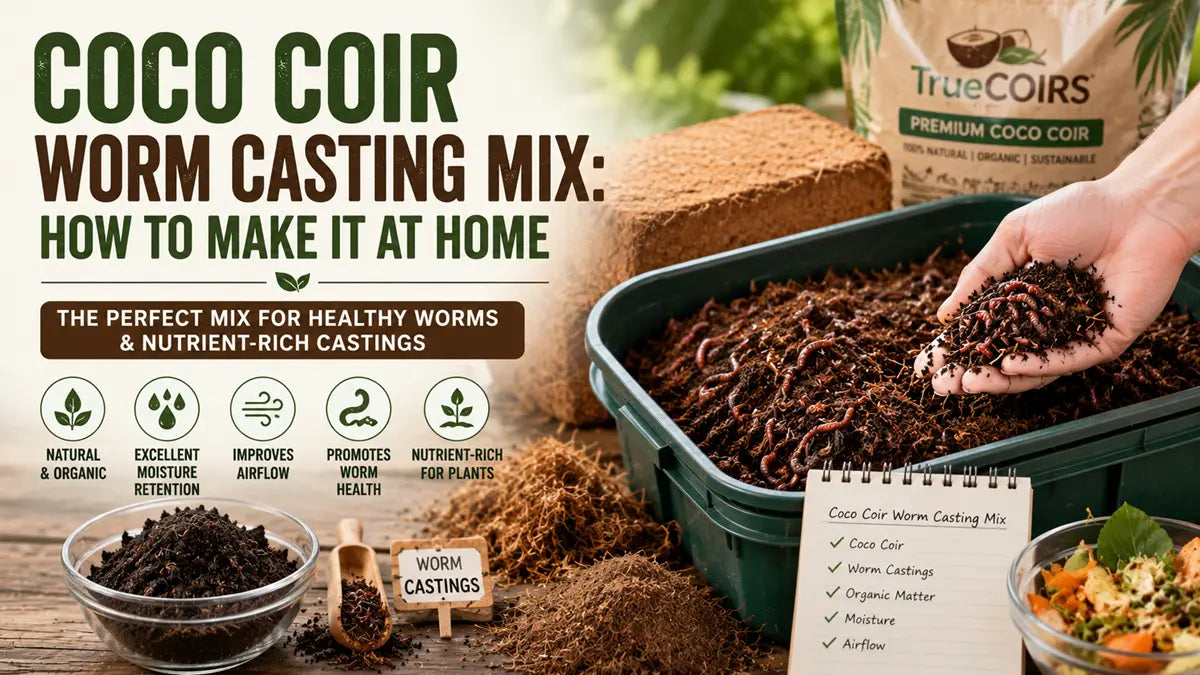
How to Make the Ideal Coco Coir Worm Casting Mix at Home
Introduction
Healthy worms need the right environment to thrive. While food scraps provide nutrition, the bedding in a worm bin provides structure, moisture, and a comfortable environment for composting worms.
Coco coir and worm castings work particularly well together because coco coir can provide a fibrous, moisture-holding material while worm castings add nutrient-rich organic matter.
If you're wondering how to make a coco coir worm casting mix at home, the process is straightforward: prepare the coir properly, balance moisture, introduce suitable composting worms, and gradually incorporate organic material.
This guide walks through the process and explains how coco coir can be used in worm bins and worm-casting mixes.
What Is Coco Coir?
Coco coir is a natural fiber obtained from coconut husks.
It is widely used in gardening, growing media, composting, and other applications because it is lightweight and can retain moisture while maintaining a fibrous structure.
Compressed coco coir products are particularly convenient because they occupy less storage space before hydration.
TrueCoirs offers compressed coco coir bricks and larger blocks that can be hydrated and expanded for applications including gardening and worm composting.
Make Worm Bedding Preparation Simple
TrueCoirs natural coco coir is available in convenient compressed formats, helping you store and prepare the coir you need for worm bins, composting, and gardening projects.
View Coco Coir Products →Why Use Coco Coir for Worm Composting?
Coco coir can serve as a worm bedding material because of its physical properties.
It can help provide:
- Moisture retention
- A fibrous structure
- Aeration within the bedding
- A lightweight growing medium
- A plant-based alternative to some conventional bedding materials
The important point is that coco coir is primarily a bedding component, not the complete food source for composting worms.
Worms still require appropriate organic material as part of a balanced vermicomposting system.
How to Make a Coco Coir Worm Casting Mix
Step 1: Choose Quality Coco Coir
Start with clean, suitable coco coir from a reliable source.
Compressed bricks are convenient for home worm bins because they are compact to store and expand substantially after hydration.
TrueCoirs' compressed coir products are designed to expand after water is added, making them practical for applications where large quantities of loose coir would otherwise take up storage space.
Step 2: Rehydrate the Coco Coir
Place the compressed coco coir brick or block into a suitable container.
Add water gradually and allow the coir to absorb it.
As it expands, break apart compressed sections and mix the material so that water reaches the entire brick.
Avoid simply flooding the coir.
The goal is moist but not waterlogged bedding.
What Should the Coir Feel Like?
A useful general test is to squeeze a handful of prepared coir.
It should feel evenly moist without being saturated.
If water pours out freely, it is too wet.
If the material is dry and difficult to break apart, it needs more moisture.
Step 3: Fluff the Coir
Once hydrated, loosen the coir by hand.
Breaking apart compressed sections creates a more uniform structure and helps prevent dense, compacted areas.
Fluffy bedding also provides worms with a more suitable environment than a tightly compressed mass.
Step 4: Check the Moisture Level
Moisture is one of the most important factors in vermicomposting.
Composting worms need a consistently moist environment, but excessive water can reduce airflow and create anaerobic conditions.
Check the bedding periodically rather than assuming that one initial hydration will keep it at the correct moisture level indefinitely.
Step 5: Add Organic Material
Coco coir alone isn't a complete worm diet.
Add suitable organic worm food gradually, such as appropriate vegetable and fruit scraps and other materials recommended for vermicomposting.
Avoid suddenly adding large amounts of food.
Too much food can decompose rapidly, potentially creating heat, odors, or other unfavorable conditions.
Step 6: Introduce Composting Worms
Once the bedding is prepared and conditions are suitable, introduce an appropriate composting worm species.
Commonly used composting worms include species such as red wigglers.
Give the worms time to adapt to their new environment before increasing feeding quantities.
Step 7: Monitor the Worm Bin
A healthy worm bin should be monitored regularly.
Look at:
- Moisture
- Temperature
- Odor
- Food quantity
- Bedding condition
- Worm activity
- Airflow
A strong rotten smell, excessive liquid, or unusual heating can indicate that something in the system needs adjustment.
Looking for Coco Coir for Your Worm Bin?
Start your vermicomposting setup with natural coco coir from TrueCoirs. Our compressed coir products are easy to store, hydrate, and prepare for worm composting applications.
Explore TrueCoirs Coco Coir ProductsWhat Is the Ideal Coco Coir to Worm Casting Ratio?
There isn't one universal ratio that works for every worm bin or every stage of vermicomposting.
The appropriate blend depends on:
- The amount of coco coir
- Moisture content
- Quantity of food
- Worm population
- Bin size
- Other bedding materials
- How mature the worm castings are
Instead of treating a ratio as an absolute recipe, use the physical condition of the bedding as your guide.
The mix should remain moist, loose, and well-aerated, without becoming waterlogged.
Coco Coir and Worm Castings for Plant Growing
Once worms have processed organic material, the resulting worm castings can be used as an organic soil amendment.
Coco coir and worm castings can also be combined as components of a growing medium.
Coco coir primarily contributes physical structure and moisture management, while worm castings contribute organic matter and nutrients.
However, neither should automatically be treated as a complete standalone potting mix for every plant.
A growing medium may require additional components depending on the plant species and growing system.
Simple Coco Coir and Worm Castings Mix
A basic home experiment can combine:
- Prepared coco coir
- Mature worm castings
- Other appropriate growing-medium components, if needed
Mix thoroughly and assess the texture and moisture before using it.
For seedlings or sensitive plants, avoid assuming that more worm castings are always better. Start conservatively and adjust according to the plant's requirements.
Coco Coir Worm Casting Mix vs. Plain Coco Coir
|
Feature |
Coco Coir |
Coco Coir + Worm Castings |
|
Moisture management |
Yes |
Yes |
|
Fibrous structure |
Yes |
Yes |
|
Organic matter |
Yes |
Increased |
|
Worm castings |
No |
Yes |
|
Suitable as worm bedding |
Yes, when properly prepared |
Yes, depending on mix |
|
Suitable as complete potting mix |
Not necessarily |
Not necessarily |
The combination can be useful because the two materials perform different functions.
Build a Better Worm-Bin Bedding Mix
Prepare your worm bedding with natural coco coir from TrueCoirs.
Common Mistakes When Making a Worm Casting Mix
Using Dry Coir
Dry compressed coir needs to be properly hydrated before being used as worm bedding.
Making the Bedding Too Wet
Excess water can reduce airflow and create unfavorable conditions.
Feeding Too Much
Worms process organic matter gradually. Overfeeding can create problems faster than worms can process the material.
Using Only Coco Coir as Food
Coco coir is primarily a bedding/substrate component. Composting worms need appropriate organic material for food.
Compressing the Bedding
Avoid creating a dense, compacted mass. Loose bedding helps maintain structure and airflow.
Ignoring Temperature
Worms are living organisms with environmental requirements. Monitor the temperature of the bin and avoid placing it somewhere exposed to excessive heat.
How to Maintain Coco Coir Worm Bedding
Maintaining your worm bin is largely about maintaining balance.
Check Moisture
Add small amounts of water when the bedding becomes too dry. If the system is excessively wet, improve drainage and airflow and review how much moisture is being introduced.
Add Fresh Bedding
Fresh, prepared coco coir can be added when the existing bedding becomes depleted or when additional structure is needed.
Feed Gradually
Add food according to the worm population and how quickly existing food is being processed.
Maintain Airflow
Avoid compacting the bedding. A breathable, appropriately structured worm bin is easier to maintain.
Need Coco Coir for Your Worm Bin?
TrueCoirs offers compressed natural coco coir designed for convenient storage and expansion. The same versatile coir material can be used across gardening, worm composting, and other organic applications.
Can You Use Coco Coir Bricks for Worm Composting?
Yes, compressed coco coir bricks can be a convenient way to prepare worm bedding at home.
The basic process is:
Compressed brick → Add water → Allow expansion → Break apart → Adjust moisture → Add to worm bin
The advantage is storage efficiency. A compressed brick takes considerably less space than the equivalent quantity of loose coir.
For people maintaining small home worm bins, this can make it easier to keep extra bedding available without storing a large bag of loose material.
Frequently Asked Questions
Is coco coir good for worm bedding?
Coco coir can be used as a worm-bedding material because it is fibrous and can hold moisture. It should be prepared properly and used as part of a balanced vermicomposting system.
Can you mix worm castings with coco coir?
Yes. Worm castings and coco coir can be combined as components of a growing medium or used together in appropriate vermicomposting applications.
Can worms live in coco coir alone?
Coco coir can provide bedding, but it should not be treated as the worms' complete food source. Composting worms require suitable organic material.
How wet should coco coir be for worms?
The bedding should be evenly moist but not waterlogged. Excessive moisture can reduce airflow and create unfavorable conditions.
Is coco coir better than peat moss for worms?
Coco coir is a renewable coconut-based material and is often considered as an alternative to peat-based materials. The best choice depends on the specific worm-bin setup and the properties required.
Conclusion
Creating a coco coir worm casting mix at home doesn't need to be complicated.
Start with quality coco coir, hydrate it thoroughly, create a loose and evenly moist bedding environment, introduce appropriate composting worms, and gradually add suitable organic material.
As the system matures, coco coir and worm castings can also become useful components of gardening mixes, giving home gardeners another way to connect vermicomposting with plant growing.
For convenient preparation and storage, compressed coco coir bricks and blocks can make an excellent starting point for home worm-bin projects.
Ready to Start Your Worm Composting Project?
Get your worm bin started with natural coco coir from TrueCoirs. Choose a convenient compressed format for easy storage, hydration, and preparation.
Explore TrueCoirs Products →