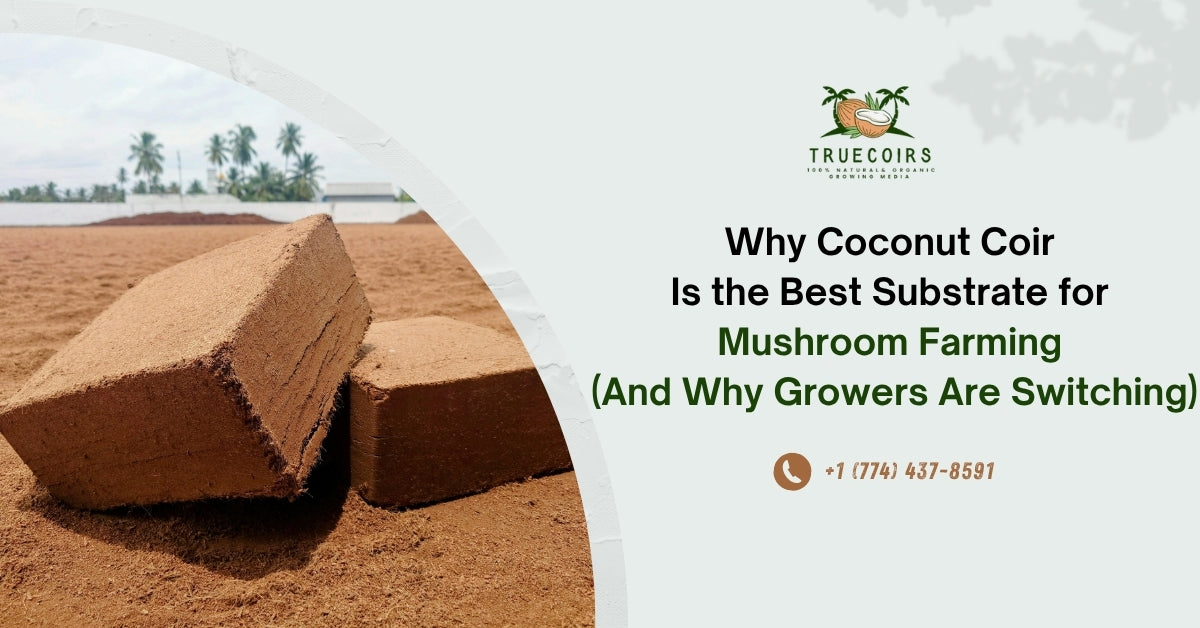
Why Coconut Coir Is the Best Substrate for Mushroom Farming (And Why Growers Are Switching)
Introduction
For commercial mushroom growers, substrate choice isn’t just a technical decision — it directly impacts yield, consistency, contamination risk, and profitability.
Across the USA, more growers are moving away from traditional substrates like straw and inconsistent organic mixes, and adopting Coconut coir as a reliable, scalable alternative.
This shift isn’t a trend — it’s driven by performance, predictability, and operational efficiency.
What Makes Coconut Coir Ideal for Mushroom Substrate?
Coconut coir, derived from Coconutnut husk fiber, offers a unique combination of properties that align perfectly with the needs of modern mushroom farms.
1. Consistent Water Retention = Stable Growth Environment
One of the biggest challenges in mushroom cultivation is maintaining optimal moisture levels.
Coconut coir:
- Retains water efficiently without becoming waterlogged
- Distributes moisture evenly across the substrate
- Reduces the risk of dry patches or oversaturation
Result: Uniform colonization and healthier flush cycles
2. Lower Contamination Risk Compared to Traditional Substrates
Contamination can wipe out entire batches.
Compared to many traditional substrates, high-quality Coconut coir:
- Has a clean, uniform structure
- Contains fewer impurities when properly processed
- Supports better control during pasteurization
Result: Reduced contamination risk and more predictable outcomes
3. Better Aeration for Strong Mycelium Growth
Healthy mycelium needs oxygen as much as moisture.
Coconut coir naturally:
- Maintains a loose, fibrous structure
- Prevents compaction over time
- Improves airflow within the substrate
Result: Faster colonization and stronger mycelial networks
4. Reliable Quality for Commercial-Scale Operations
Inconsistent substrate = inconsistent yields.
With premium Coconut coir:
- Each batch offers uniform texture and performance
- No variability like agricultural waste-based substrates
- Easier to standardize processes across grow cycles
Result: Scalable and repeatable production
5. Efficient Handling & Preparation
Operational efficiency matters at scale.
Coconut coir is:
- Lightweight and compact (especially in compressed form)
- Easy to hydrate and prepare
- Less labor-intensive compared to bulky substrates
Result: Lower labor effort and faster turnaround time
6. Supports Higher Yield Consistency
Yield variability is a major issue in commercial farming.
Coconut coir helps:
- Maintain stable growing conditions
- Support multiple flush cycles effectively
- Reduce batch-to-batch variation
Result: More predictable and consistent yields
Why More USA Mushroom Growers Are Switching to Coconut Coir
The US mushroom market is becoming increasingly competitive, with growers focusing on:
- Efficiency
- Scalability
- Quality consistency
Coconut coir aligns perfectly with these priorities by offering:
- Reliable supply (unlike seasonal substrates)
- Standardized performance
- Compatibility with modern growing systems
Choosing the Right Coconut Coir Matters
Not all Coconut coir delivers the same results.
For mushroom cultivation, growers should look for:
- Low EC (Electrical Conductivity)
- Properly washed and processed material
- Consistent texture and fiber composition
Using substandard coir can negate all the benefits mentioned above.
Final Thoughts
Coconut coir is no longer an alternative substrate — it’s becoming the preferred standard for modern mushroom farming.
For growers aiming to improve:
- Yield consistency
- Operational efficiency
- Contamination control
Coconut coir offers a proven, scalable solution.
)