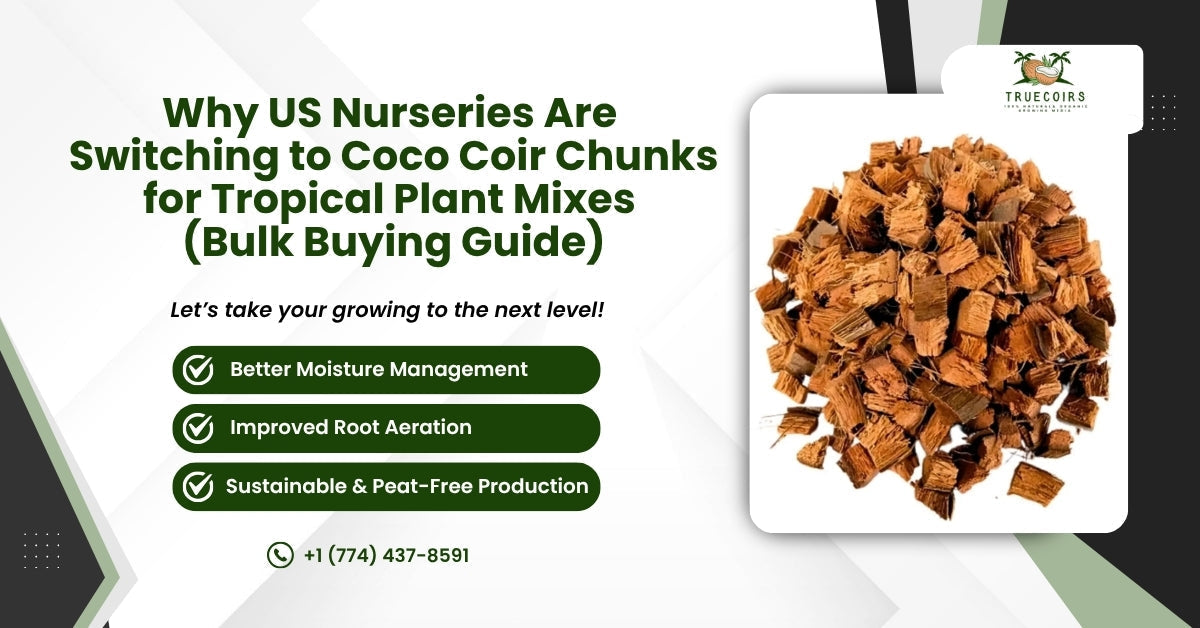
Why US Nurseries Are Switching to Coco Coir Chunks for Tropical Plant Mixes (Bulk Buying Guide)
Highlights / Key Takeaways
- Coco coir chunks are becoming a preferred substrate for commercial nurseries and tropical plant growers.
- Bulk coco chunks provide consistent aeration and moisture retention for greenhouse production.
- Many growers are replacing peat moss and bark with sustainable coconut-based substrates.
- Coco chunks help create premium chunky mixes for monstera, philodendrons, and orchids.
- Buying coco coir chunks in bulk can reduce long-term nursery substrate costs.
Introduction
Across the United States, commercial nurseries are rapidly shifting toward sustainable growing media — and coco coir chunks are leading the transition.
As demand grows for tropical houseplants, orchids, aroids, and peat-free gardening products, growers need substrates that offer:
- Reliable drainage
- Moisture consistency
- Long-term structural stability
- Scalable supply chains
Traditional bark-based substrates and peat-heavy mixes are becoming more expensive and environmentally scrutinized. In response, many nurseries are adopting coconut coir chunks as a modern solution for tropical plant production.
This guide explains why coco coir chunks are gaining popularity in US greenhouse operations and what buyers should look for when purchasing in bulk.
What Are Coco Coir Chunks?
Coco coir chunks are coarse chips made from processed coconut husks.
Unlike fine coco peat, chunky coconut coir creates large air pockets that support root oxygenation while retaining enough moisture for healthy tropical growth.
They are commonly used in:
- Tropical plant mixes
- Orchid substrates
- Aroid soil blends
- Greenhouse production systems
- Hydroponic cultivation
Why Nurseries Prefer Coco Coir Chunks
Better Moisture Management
One major challenge in commercial production is maintaining consistent moisture levels across thousands of plants.
Coco chunks hold water more evenly than many bark-based substrates, helping reduce rapid dry-outs in greenhouse environments.
This is especially valuable for:
- Monsteras
- Philodendrons
- Anthuriums
- Young tropical starters
- Indoor foliage production
Improved Root Aeration
Healthy roots require oxygen.
The chunky structure of coconut coir allows airflow throughout the container while reducing compaction over time.
Many nurseries combine:
-
Coco chunks
-
Perlite
-
Pumice
-
Coco peat
-
Charcoal
to create premium chunky tropical mixes.
Growers searching for better drainage performance often compare coco chunks vs orchid bark to determine which substrate offers the best long-term aeration and durability.
Sustainable & Peat-Free Production
Sustainability is becoming a major purchasing factor for both growers and consumers.
Peat harvesting faces increasing environmental concerns, while bark availability can fluctuate depending on forestry production.
Coco coir chunks provide a renewable alternative because they are produced from recycled coconut husks.
Sustainability Advantages of Coco coir chunks:
- Renewable agricultural byproduct
- Reduced peat dependency
- Lower environmental impact
- Biodegradable substrate option
- Supports eco-friendly branding
Many US consumers now actively seek peat-free and environmentally conscious houseplant products.
Commercial Benefits of Buying Coco Chunks in Bulk
Cost Efficiency
Bulk purchasing helps nurseries:
- Lower substrate costs
- Improve inventory consistency
- Reduce shipping variability
- Standardize production recipes
Commercial growers also benefit from compressed packaging formats that optimize warehouse storage and freight logistics.
Consistency Across Production
Uniform substrate quality matters in greenhouse operations.
Premium coco coir chunk suppliers provide:
- Consistent particle sizing
- Proper washing and buffering
- Low salt content
- Stable moisture performance
This helps growers avoid inconsistencies that can affect root development and watering schedules.
Best Tropical Plants for Coco Chunk Mixes
Coco chunk substrates perform especially well for:
- Monsteras
- Philodendrons
- Anthuriums
- Orchids
- Hoyas
- Alocasias
- Epiphytic tropical plants
Growers can also customize blends depending on humidity and irrigation systems.
For nurseries creating specialty indoor plant mixes, learning how to use coco coir chunks for orchids without root rot can help improve customer success and reduce plant losses.
What to Look for in a Bulk Coco Coir Supplier
When sourcing coco chunks for commercial operations, nurseries should prioritize:
Washed & Buffered Products
Prevents excess salts from affecting root health.
Consistent Chunk Size
Improves predictable watering and aeration.
Reliable Supply Chains
Critical for year-round production planning.
Sustainable Manufacturing
Supports environmentally conscious branding.
Compression Efficiency
Helps reduce freight and storage costs.
Mid-Article CTA
Why the Demand for Coco Chunks Is Growing in the USA
Several trends are accelerating adoption:
Houseplant Boom
The popularity of monstera, philodendrons, and rare tropical plants continues growing.
Sustainability Awareness
Consumers increasingly prefer peat-free and renewable gardening products.
Greenhouse Efficiency
Nurseries need substrates that balance moisture retention with airflow.
Premium Potting Mixes
Chunky tropical mixes command higher retail value in garden centers and ecommerce stores.
Conclusion
Coco coir chunks are quickly becoming one of the most important substrates in modern tropical horticulture.
For US nurseries, they offer:
- Reliable moisture retention
- Excellent root aeration
- Sustainable sourcing
- Commercial scalability
- Premium mix performance
As tropical plant demand continues growing, nurseries investing in high-quality coco chunk substrates will be better positioned to deliver healthier plants and environmentally conscious products.
Final CTA
Sources & Citations:
-
Royal Horticultural Society (RHS) — Peat-Free Growing Media & Sustainable Alternatives
https://www.rhs.org.uk/soil-composts-mulches/peat-free -
University of Florida IFAS Extension — Coconut Coir as a Sustainable Growing Medium
https://edis.ifas.ufl.edu/publication/HS1266 -
NC State Extension — Container Substrates for Greenhouse Crops
https://content.ces.ncsu.edu/container-substrates-for-greenhouse-crops -
Scientia Horticulturae — Coconut Husk Chips & Coir-Based Growing Media Research
https://www.sciencedirect.com/science/article/pii/S0304423821002405 -
HortTechnology Journal — Physical Properties of Coconut Coir Substrates
https://journals.ashs.org/horttech/view/journals/horttech/10/4/article-p783.xml -
Greenhouse Management Magazine — Trends in Sustainable Greenhouse Substrates
https://www.greenhousemag.com/ -
University of Arkansas Division of Agriculture — Soilless Growing Media & Water Retention
https://www.uaex.uada.edu/yard-garden/in-the-garden/reference-desk/plant-week/soilless-potting-mixes.aspx
)